
Disclaimer: This post contains affiliate links, which means I may earn a small commission at no extra cost to you if you make a purchase through my links. Thank you for supporting Dog in Focus! 🐾
If you’ve ever sat in silence and heard that soft, persistent whine coming from your dog — you know how it goes straight to your heart.
Is she in pain? Is something wrong? Does she need something I’m not giving her?
I’ve been there with Bella more times than I can count. That whining sound used to make me panic. Now, after years of paying attention and learning her language, I understand it — and honestly, it’s made our bond so much deeper.
Why is my dog whining? Let me walk you through every real reason, one by one.

Why Is My Dog Whining? The Short Answer
Whining is communication. Dogs don’t have words — so they use sound, body language, and behavior to tell us what they need.
The key is learning which whine means what.
And yes — they’re different. Once you tune in, you’ll start to hear the unique story your pup is telling you.
1. She Wants Your Attention (And She Knows It Works)
Sometimes, it really is that simple: your dog whines because she’s learned it gets results.
If you’ve ever looked up from your phone or rushed over the moment she started whining — congratulations, you’ve accidentally trained her to do it.
Dogs are incredibly smart. They repeat what works. If whining equals immediate attention from their favorite human, expect more whining.
Bella used to do this every single time I sat at my desk. I’d look up, she’d wag her tail. Classic.
What to do: Don’t reward the whining with immediate attention. Wait for a moment of quiet, then give her love and affection. Always reward the calm, never the noise.
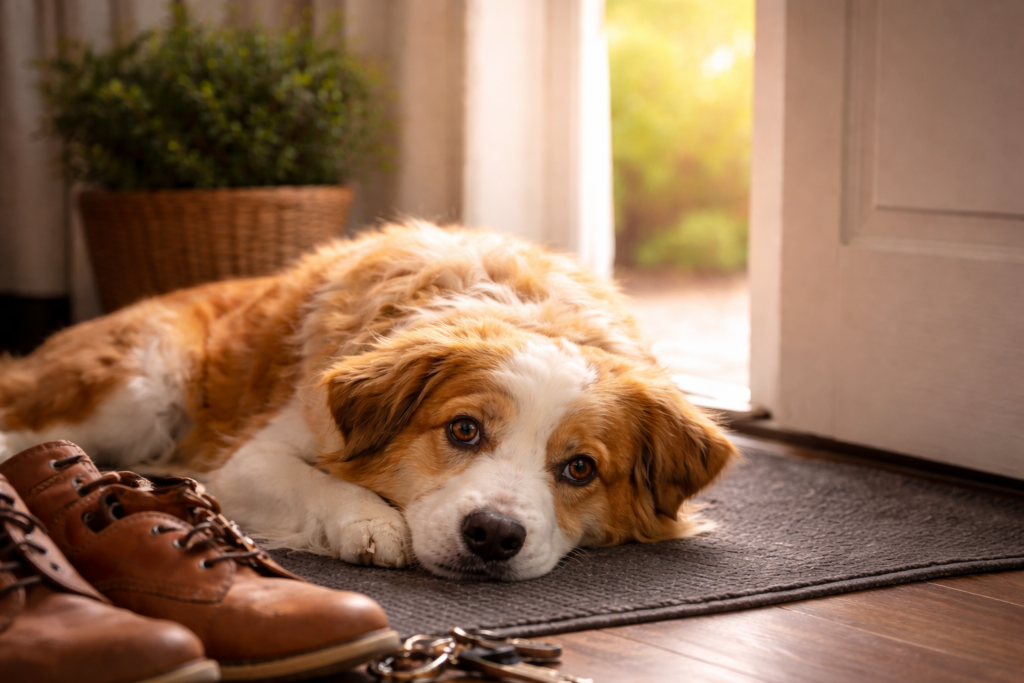
2. Anxiety or Stress (Why Your Dog Is Whining When You Leave)
This is one of the most common — and most heartbreaking — reasons dogs whine.
If your dog whines when you’re getting ready to leave, when there are loud noises outside, or when the daily routine shifts, anxiety is almost always the root cause.
Signs of anxiety whining:
- Happens right before you leave the house
- Accompanied by pacing or restlessness
- Gets worse when they are left completely alone
- Comes with panting, shivering, or clinging to your side
If you recognize your dog here, read our complete guide: Dog Separation Anxiety: Why It Happens and How to Help.
What to do: Build a calm, predictable departure routine. Never make goodbyes dramatic or emotional. A consistent schedule and mental enrichment make a massive difference.
The Brain Training for Dogs program helped Bella dramatically with this. It teaches dogs how to self-regulate and feel secure, even when you’re not right beside them.
3. She Needs Something Basic
Food. Fresh water. A quick bathroom break. Or maybe a favorite toy stuck under the couch.
Before you go deep into behavioral analysis, always check the basics first. Dogs whine to communicate physical needs, and sometimes the solution is wonderfully simple.
Quick checklist:
- When did she last eat? 🍽️
- When did she last go outside? 🌿
- Is her water bowl empty? 💧
- Is she staring intently at something out of reach?
I honestly can’t tell you how many times Bella’s “mysterious whining” turned out to be a tennis ball stuck under the sofa.
What to do: Do a quick physical scan of her environment before assuming the worst. Sometimes the answer is right in front of you.
4. Pain or Physical Discomfort
This is the one that worries every dog owner the most — and rightfully so.
If your dog’s whining is sudden, intense, or completely out of character, pay close attention to her body language.
Signs the whining might be pain-related:
- Sudden onset with no obvious trigger
- Whining or tensing up when touched in a specific area
- Limping, stiffness, or reluctance to get up and move
- Loss of appetite alongside the whining
What to do: If you suspect physical pain, never wait it out. Contact your trusted veterinarian. You know your dog better than anyone — always trust your instincts.

5. Excitement — The Happy Whine
Not all whining is sad, anxious, or painful. Some dogs simply whine when they are thrilled out of their minds.
The leash comes out? Whine. You walk through the front door after work? Whine. It’s almost dinner time? Whine.
This kind of whining comes with a furiously wagging tail, bouncy energy, and zero signs of distress. It’s pure, unfiltered joy — just a little bit noisy.
What to do: Enjoy it! 😄 If it becomes overwhelming, teach a calm greeting routine — wait for four paws firmly on the floor before giving her attention and affection.
6. Learned Behavior
Dogs learn exceptionally fast. If whining has ever successfully gotten your dog what she wanted in the past, her memory file locked it in.
It’s not manipulation; it’s just dogs being dogs. They are hardwired to repeat whatever behavior brings results.
What to do: Be fiercely consistent. If you sometimes give in to the whine and sometimes ignore it, she will only whine harder — trying to figure out which rule applies today. Consistency is your best friend here.
7. She Feels Insecure
A new home. A new baby. A new pet. A schedule change.
Dogs are deep creatures of habit, and unexpected life changes can feel genuinely scary for them. Whining in these moments is your dog reaching out and whispering: “I don’t understand what’s happening — are you still here with me?”
What to do: Offer extra reassurance during major transitions. Keep as much of her daily routine steady as possible. And most importantly, create a safe, cozy space that belongs entirely to her — a quiet sanctuary where she can retreat when the world feels like too much.
A quality calming dog bed can make a world of difference here — something soft, enclosed, and warm that hugs her body. Bedsure Calming Dog Bed
How to Stop Dog Whining — A Simple Framework
Before reacting to the noise, pause and ask yourself:
- Is this a basic need? → Check food, water, and the yard.
- Is this physical pain? → Watch for guarding or limping.
- Is this anxiety? → Look for environmental triggers.
- Is this attention-seeking? → Wait for silence before responding.
- Is this learned behavior? → Stay consistent with your boundaries.
Once you identify the why, the solution becomes much clearer, turning a moment of stress into a moment of connection.
Related Behaviors Worth Understanding
Whining rarely happens all by itself. If your dog whines, you might also notice her doing things like:
- Following you into every room → Why Does My Dog Follow Me Everywhere? 7 Real Reasons That Finally Make Sense
- Leaning against your legs constantly → Why Does My Dog Lean on Me? 5 Heartwarming Reasons Revealed
- Staring at you with wide, soft eyes → Why Does My Dog Stare at Me? 5 Heartwarming Reasons Revealed
These behaviors are all connected — they are your dog’s gentle ways of staying tethered to the person she trusts most in this world.
The Bottom Line
Why is my dog whining?
Because she’s trying to talk to you.
She doesn’t have human words — she has sounds, looks, and little behaviors. And every single one of them is aimed at you, because you are her entire world.
Learning her language isn’t just about better training. It’s how you build the kind of profound bond where she feels completely understood — and you feel like you truly know her.
That’s worth everything. 🐾
What Does Your Dog’s Whine Sound Like?
Drop a comment below — is it the anxious whine? The happy greeting whine? Or the classic “I’m hungry and I know you know it” whine? 😄 We’d love to hear your story!
Related Reading:
- Why Does My Dog Follow Me Everywhere? 7 Real Reasons That Finally Make Sense
- Why Does My Dog Lean on Me? 5 Heartwarming Reasons Revealed

Andrea Frota is the creator of Dog In Focus, a blog dedicated to helping dog owners better understand dog behavior, training, health, and everyday care. Through carefully researched articles and practical guidance, Andrea shares helpful information to support responsible and confident dog ownership.